Civil engineers design, build and maintain the spaces and places that shape our day-to-day existence. They are involved in the construction and maintenance of buildings and structures, roads, railways, bridges, water supply and waste networks.
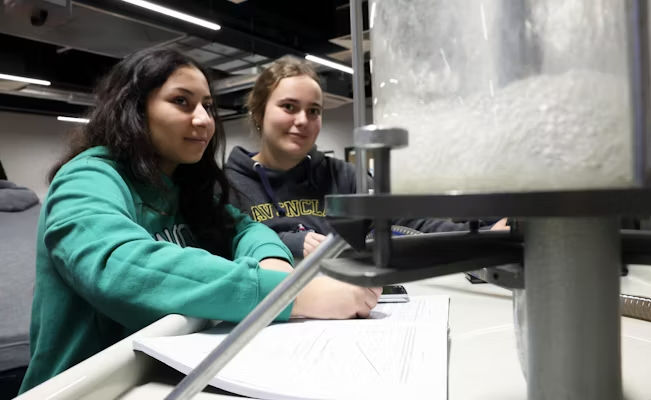
Through laboratory sessions, field trips, individual projects and design classes, students will embed the knowledge from their lectures and tutorials and develop their practical abilities in surveying and design.
Students will choose from a range of authentic, real-world engineering problems and industry-focused scenarios, to work on both individually and with other student engineers. Group work mirrors the relationships of an engineering team and will help students to build professional skills, such as teamwork, project management and communication.
Tuition fees
Fee
Programme start date
Fee for Kazakhstani students
US$16,000 per year
September 2026
Fee for international students
US$18,000 per year
September 2026
Entry requirements
To enter this four-year undergraduate degree programme you will need:
to successfully complete the ATTESTAT/Certificate of Secondary Education with an overall average of 4 or above from the grade 11 transcript, to include a grade of 4 or above in mathematics
a minimum IELTS score of 6.0 (with no component below 5.5) or an equivalent proof of English proficiency such as TOEFL or the Cardiff University English Language Test.
The entry requirements are specifically for admission to Cardiff University Kazakhstan. Find out more about the Kazakhstan Government Scholarship on our website and using local sources.
Modules
Foundation Year (60 ECTS)
The first year of our four-year degree programmes is a foundation year to provide students with the academic knowledge, English language competencies, and study skills needed to progress into degree-level studies.
Academic English language modules will help strengthen your English language skills, before you study further modules focused on the relevant skills and knowledge required to progress into undergraduate study.
Academic Writing and Study Skills
Credits: 10 ECTS
This module aims to improve students’ proficiency in English writing and develop essential academic writing skills. It will focus on writing in an academic style, including written accuracy, formal register, and the ability to plan, draft, evaluate, and edit academic written work.
Additionally, it aims to develop the use of academic grammar and vocabulary, presenting coherent arguments, and solving problems. This module emphasises learner training, which includes self-reflection, goal-setting and evaluation, to better prepare students for their academic studies.
Learning outcomes
Draft, plan, write and review a structured essay using an appropriate academic style and range of academic features effectively.
Identify and use academic vocabulary in written work.
Synthesise information from a range of academic sources to develop a timed argumentative essay.
English for Communication Skills
Credits: 10 ECTS
This module aims to develop students’ academic presentation skills and research methods (including use of library and database systems) with a focus on the importance of appropriate and accurate referencing.
Classes also aim to develop effective reading and listening techniques for comprehension and summary tasks, and critical evaluation skills. This module emphasises learner training, which includes self-reflection, goal-setting and evaluation, to better prepare students for their academic studies.
Learning outcomes
Identify key points in listening extracts to complete comprehension and summary tasks.
Identify key points in reading texts to complete comprehension and summary tasks.
Conduct research using library and online resources.
Apply the Cardiff University Harvard Referencing system.
Prepare and deliver effective academic presentations.
Scientific Thinking
Credits: 10 ECTS
This module introduces you to how science works and how scientists investigate the world. You will become more comfortable asking questions and learn to design simple experiments, and carefully analyse results. You will also learn to think critically, work independently, and study effectively in a UK university setting.
You will practise how to read scientific information, spot mistakes or weak arguments, and share your ideas clearly through posters, videos, and presentations.
Learning outcomes
Apply the scientific method to create testable hypotheses and design simple experiments based on observation and logical reasoning.
Identify strengths and weaknesses in scientific information by evaluating evidence and recognising bias or limitations in research claims.
Analyse and interpret data using appropriate methods to find patterns and draw logical and valid conclusions.
Communicate scientific ideas clearly through a short video presentation and visual tools, using correct scientific terms and presentation techniques.
Demonstrate the ability to reflect on the scientific method and your own learning process using study skills relevant to higher education.
Mathematical Foundations
Credits: 10 ECTS
This module helps you build strong skills in key areas of mathematics such as algebra, trigonometry, and geometry. You will learn how to solve problems, think logically, and understand important mathematical ideas. These skills are essential to study a degree on Physical Sciences and Engineering.
You will explore how to work with different kinds of equations, graphs, and shapes. You will also begin learning basic calculus, including how to find slopes and areas using simple rules.
Learning outcomes
Accurately simplify and manipulate algebraic expressions and functions, including polynomials, rational expressions, exponents, to solve problems.
Solve and interpret linear, quadratic, simultaneous, and trigonometric equations and inequalities using appropriate algebraic and graphical methods.
Use coordinate geometry and vector operations to solve geometric problems involving lines, circles, and basic conic sections in two dimensions.
Apply trigonometric rules, graphs, identities, and inverse functions to solve problems involving angles, triangles, and periodic patterns in radians and degrees.
Data Science and Statistics
Credits: 10 ECTS
This module introduces you to the fundamental principles and techniques of data analysis, providing a foundation in data collection, cleaning, and manipulation, alongside essential descriptive statistics and data visualisation methods.
You will learn how to summarize and interpret data effectively, identify patterns and trends, and gain a basic understanding of inferential statistics, including hypothesis testing and confidence intervals. The module emphasises practical application, enabling students to analyse real-world data sets and draw meaningful conclusions.
Learning outcomes
Collect and organize data from various sources, and prepare it for analysis using appropriate techniques.
Calculate and interpret descriptive statistics, including measures of central tendency, dispersion, and correlation.
Visualise data effectively using a range of graphical methods, such as histograms, scatter plots, and box plots.
Perform basic inferential statistical tests, and interpret the results.
Communicate findings from data analyses clearly and concisely, using appropriate statistical terminology and visualisations.
Mathematical Modelling and Applications
This module introduces you to the powerful combination of mathematics and computation for understanding and simulating real-world phenomena. You will learn the basic rules of calculus and core programming principles to turn mathematical ideas into working computer programs.
Learning outcomes
Write simple algorithms using variables and conditional statements to model mathematical problems.
Differentiate standard mathematical functions from first principles and apply rules such as the product, quotient, and chain rules to solve practical problems.
Translate mathematical problems into clear computational algorithms and accurately implement them in code.
Analyse simple mathematical models that use calculus and simulation of differential equations by applying numerical methods and visualization techniques.
Apply computational thinking and programming skills to investigate and solve problems in scientific and mathematical contexts by integrating advanced modelling, simulation, and visualisation methods.
Kazakh Language and History
Additional course.
Year one (60 ECTS)
Module title
Credits
Engineering Maths and Computation
20 ECTS
Fundamentals of Civil Engineering
20 ECTS
Applied Design and Practice
20 ECTS
Year two (60 ECTS)
Module title
Credits
Engineering Analysis
10 ECTS
Building Modelling
5 ECTS
Hydraulics and Soil Mechanics
10 ECTS
Structural Analysis & Design Theory
15 ECTS
Sustainable Civil Engineering Design & Practice
15 ECTS
Environmental Engineering
5 ECTS
Year three (60 ECTS)
Module title
Credits
Construction and Construction Management
5 ECTS
Structural Analysis
5 ECTS
Water Engineering
5 ECTS
Geotechnical Engineering
5 ECTS
Structural Design Studies
5 ECTS
Civil Engineering Design
5 ECTS
Project
15 ECTS
Optional modules
In year three, students will also select 15 ECTS credits from a range of optional modules, including:
Module title
Credits
Concrete Materials and Structures
5 ECTS
Finite Elements for Full-scale Engineering Problems
5 ECTS
Environmental Geotechnics
5 ECTS
Environmental Hydraulics
5 ECTS
Apply
Apply for Civil Engineering (BEng) with a Foundation Year at Cardiff University Kazakhstan.